What is breathing biofeedback?
Breathing biofeedback means seeing a signal from your body as it happens, such as your heart rhythm, your breathing pattern or the carbon dioxide in your out-breath, so you can learn to change it. The best-studied kind, heart rate variability biofeedback, has been linked in reviews to lower self-reported stress and anxiety, but researchers still want better-controlled trials, and the evidence for the other kinds is thinner.
The short answer
- What it is: a live signal from your body, shown back to you while you breathe, so you can see what your breathing is doing.
- Three main kinds: heart rate variability (HRV) biofeedback, breath-pattern feedback, and capnometry, which measures carbon dioxide (CO2) in your breath.
- The evidence is strongest for HRV biofeedback. Reviews linked it to less self-reported stress and anxiety, and called for better-controlled trials.
- Capnometry has been studied mainly in panic disorder, with a clinician. In one trial with veterans with PTSD, it did not reduce symptoms.
- Most breathing apps follow a timer. A few respond to your breath or your heart. Here's the difference.
What is biofeedback?
Biofeedback turns something happening inside you into something you can see or hear. A sensor measures a body signal, a screen or a sound shows it back to you straight away, and over time you learn which changes move it, and which way.
Breathing is a natural place to start, because it is something you can change on purpose. Changing it also moves other signals. A review of 223 studies found that slow breathing raised heart rate variability, a measure linked to the body's "rest and digest" system, during practice, straight after a single session and after courses of several sessions (Laborde 2022).
The three kinds of breathing biofeedback
They differ in what they measure, and so in the kit they need.
| Kind | What it shows you | Usual kit | Studied mostly in |
|---|---|---|---|
| Heart rate variability (HRV) biofeedback | The changing gaps between your heartbeats while you breathe slowly | A heart rate sensor linked to a screen, often a phone or tablet | Stress, anxiety and low mood, in many groups |
| Breath-pattern feedback | How fast, deep and even your breathing is | A breathing sensor or device, or a phone's own sensors | Small trials in specific situations, such as exams |
| Capnometry (CO2) feedback | The carbon dioxide in your out-breath, plus breathing rate | A portable capnometer, a sensor that samples your breath | Panic disorder, usually with a clinician |
Details of each, and the studies behind them, are below.
What the research says
Heart rate variability biofeedback
Your heart doesn't beat like a metronome: the gaps between beats keep changing, and that variation is called heart rate variability. In HRV biofeedback you breathe slowly while a sensor shows those changes. Standard programmes first work out a personal breathing rate for each person, called their resonance frequency; others use a fixed rate of six breaths a minute (0.1 Hz) (Sumińska 2026).
A 2017 review pooled 24 studies with 484 people. HRV biofeedback was linked to a large drop in self-reported stress and anxiety compared with control groups, and the authors said more well-controlled studies are needed (Goessl 2017). A wider review of 58 randomised controlled studies found a small to moderate effect across many outcomes, from anxiety to sports performance. Effects were larger against inactive control groups than against other active approaches, and the authors said more research is needed for each specific use (Lehrer 2020).
Doing it at home looks less clear-cut for stress. A review of 18 studies with 1,352 people looked at HRV biofeedback done remotely, such as at home with a device. Compared with control groups, it had a medium effect on depressive symptoms and on HRV itself, but its effect on stress was not statistically significant (Vann-Adibe 2026).
Whether the exact pace matters is still unclear. In a four-week randomised trial with 88 people, those breathing at their personal resonance frequency and those breathing at a fixed six breaths a minute both reported less stress, anxiety and depressive symptoms than a control group, with no meaningful difference between the two. Their resting HRV did not change (Sumińska 2026).
Breath-pattern feedback
Here the signal is your breathing itself: its speed, depth and rhythm. The research is smaller and more mixed.
In a trial with 34 university students during their exams, only the group using a biofeedback breathing device reported a significant drop in test anxiety. Students doing breathing exercises on their own, or given information about test anxiety, did not (Rosenberg 2021). In a trial with 60 adults having a tooth taken out, those using a breathing biofeedback device breathed more slowly during the extraction and scored about 2 points lower afterwards on a questionnaire about how anxious they felt right then. Measures of their general dental anxiety and fear showed no difference (Wong 2025).
Not every study finds that the feedback itself adds something. In a lab study, people meditated in virtual reality after being put under stress. Arousal fell in every group, but it fell most for people whose visuals were not linked to their breathing at all. The researchers concluded that the breathing feedback had no added value for lowering arousal there (Tinga 2019).
Capnometry (CO2) feedback
Capnometry training shows you the carbon dioxide in your out-breath as you breathe, and teaches you to raise it. It has been studied mainly as a therapy for panic disorder, set up and supported by clinicians (Meuret 2008).
In a trial with 37 people with panic disorder, four weeks of capnometry-assisted breathing therapy led to improvements in panic severity that were not seen in people waiting for treatment, and the gains held at follow-up a year later. The authors called the evidence preliminary (Meuret 2008).
It hasn't helped everywhere it has been tried. In a trial with 80 US military veterans with post-traumatic stress hyperarousal, capnometry-assisted training lowered their breathing rate but did not reduce their symptoms compared with a waiting list (Jamison 2022).

In plain terms: HRV biofeedback has the most research behind it: people in these studies reported less stress and anxiety, and the researchers still want better-controlled trials. Breath-pattern feedback has a handful of small studies with mixed results. Capnometry has been tested mainly as a clinician-led therapy for panic disorder. None of this research makes biofeedback a substitute for care when you need it.
How breathing apps differ
Breathing apps tend to fall into three groups:
- Timer apps. A shape grows and shrinks, or a bar fills, and you breathe along. This is paced breathing. The app tells you what to do but doesn't know what you actually did.
- Voice-guided apps. A teacher talks you through each breath, often with music. Also paced, just with a person instead of a shape.
- Apps that respond to you. These measure something and show it back, which makes them biofeedback. Some read your heart through a sensor for HRV biofeedback. A few follow your breath itself.
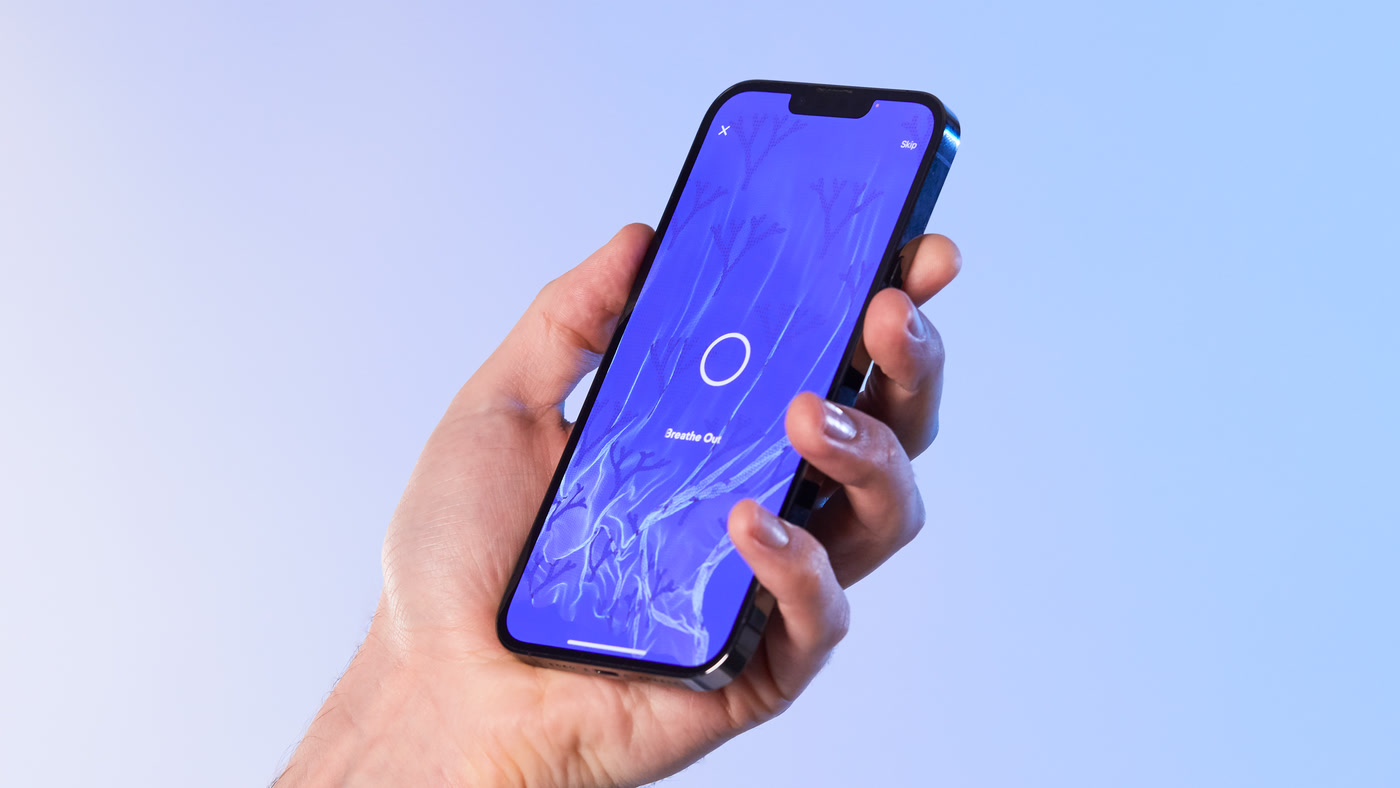
Lungy is in the last group, and it follows your breath rather than your heart. It uses the iPhone's microphone and camera together to tell when you breathe out, and the scene on screen moves as you do: dandelion seeds blow away, rain falls, particles scatter. A guide on screen also shows when to breathe in, hold and breathe out. Breath-responsive scenes are opt-in and need permission to use the microphone and camera.
Where Lungy falls short: it doesn't measure your heart rate or carbon dioxide, so it isn't HRV biofeedback or capnometry. It is iPhone only, and breath tracking works best somewhere quiet. There's no account, it works without the internet, and your breathing data stays on your phone. You get one exercise a day free; the rest needs Lungy Deluxe, $29.99 a year. Get Lungy on the App Store.
For a wider comparison, including apps that use a heart rate sensor, see the best breathing apps in 2026.
How to try it
You can get a feel for slow breathing in your browser, for free. Our coherent breathing exercise paces you at five and a half seconds in and five and a half out, which works out at about five and a half breaths a minute, close to the six a minute used in some HRV biofeedback programmes (Sumińska 2026). It and the other Lungy Breathe exercises follow a timer and don't respond to your breath, so they are paced breathing rather than biofeedback.
- Sit comfortably and let your shoulders drop.
- Breathe in gently through your nose, then let the breath out slowly. Don't force either one.
- Keep going for a few minutes. If you feel light-headed or uncomfortable, stop and breathe normally.
To see your breath move something, try Lungy on iPhone, or an HRV app with a heart rate sensor if you want to watch your heart rhythm instead. Curious what is happening in your body as you breathe? Our free guide What happens when we breathe? explains it, and Self-care for anxiety covers where breathing fits in. We look at the evidence for breathing apps and anxiety in Can a breathing app help with anxiety?
When to see a GP
Breathing practice, with or without biofeedback, is self-care, not treatment. In the studies above, capnometry for panic disorder was set up and supported by clinicians. See a GP if anxiety lasts for weeks, keeps coming back, or gets in the way of work, sleep or relationships, or if you have panic attacks (NHS). In England you can also refer yourself to NHS Talking Therapies.
If you are in crisis or think you might harm yourself, call 999 or go to A&E. In the UK and Ireland you can call Samaritans free on 116 123, day or night. Elsewhere, call your local emergency number. See also our medical disclaimer.
Common questions
Is breathing biofeedback the same as paced breathing?
No. In paced breathing you follow a set rhythm, such as a shape that grows and shrinks on a timer. In biofeedback, a sensor measures something your body is doing and shows it back to you as it changes. Some heart rate variability biofeedback programmes combine the two: you breathe slowly at a set pace while watching your heart rate data.
Does breathing biofeedback work?
The best evidence is for heart rate variability biofeedback. Reviews have linked it to lower self-reported stress and anxiety, though the authors call for better-controlled trials. Evidence for breath-pattern feedback and carbon dioxide (capnometry) feedback comes from fewer, smaller studies, mostly in specific groups such as people with panic disorder.
Do I need special equipment for breathing biofeedback?
It depends on the kind. Heart rate variability biofeedback needs a heart rate sensor. Capnometry needs a capnometer, a sensor that samples your out-breath, and in studies it was set up with a clinician. Breath-pattern feedback can use a breathing sensor or, in some apps, the phone's own sensors. Lungy uses the iPhone's microphone and camera.
Is there a breathing app that responds to your breath?
Yes, a few. Lungy follows your breath using the iPhone's microphone and camera together, and the scene on screen moves as you breathe out. It is iPhone only. You get one exercise a day free; the rest needs Lungy Deluxe, $29.99 a year.
Can biofeedback replace treatment?
No. Breathing practice is self-care, not treatment. If stress, anxiety or panic attacks are persistent or getting in the way of daily life, speak to a GP (NHS).
Sources
Checked on 24 November 2026. Spotted something wrong? Tell us and we will fix it.
- Goessl VC, Curtiss JE, Hofmann SG. The effect of heart rate variability biofeedback training on stress and anxiety: a meta-analysis. Psychological Medicine 47(15), 2578–2586 (2017). doi.org/10.1017/S0033291717001003
- Lehrer P et al. Heart rate variability biofeedback improves emotional and physical health and performance: a systematic review and meta analysis. Applied Psychophysiology and Biofeedback 45(3), 109–129 (2020). doi.org/10.1007/s10484-020-09466-z
- Vann-Adibe S et al. Efficacy and methodology of remote heart rate variability biofeedback interventions for mental health: a systematic review and meta-analysis. Applied Psychophysiology and Biofeedback 51(3), 441–452 (2026). doi.org/10.1007/s10484-025-09750-w
- Sumińska S, Rynkiewicz A, Szulczewski M. Resonance frequency versus fixed 0.1 Hz breathing in HRV biofeedback: a four-week randomized comparison. Scientific Reports 16 (2026). doi.org/10.1038/s41598-026-53333-6
- Laborde S et al. Effects of voluntary slow breathing on heart rate and heart rate variability: a systematic review and a meta-analysis. Neuroscience and Biobehavioral Reviews 138, 104711 (2022). doi.org/10.1016/j.neubiorev.2022.104711
- Rosenberg A, Hamiel D. Reducing test anxiety and related symptoms using a biofeedback respiratory practice device: a randomized control trial. Applied Psychophysiology and Biofeedback 46(1), 69–82 (2021). doi.org/10.1007/s10484-020-09494-9
- Wong NSM et al. The use of a respiratory biofeedback instrument in managing fear and anxiety in clinical practice. International Dental Journal 75(5), 100882 (2025). doi.org/10.1016/j.identj.2025.100882
- Tinga AM et al. Respiratory biofeedback does not facilitate lowering arousal in meditation through virtual reality. Applied Psychophysiology and Biofeedback 44(1), 51–59 (2019). doi.org/10.1007/s10484-018-9421-5
- Meuret AE, Wilhelm FH, Ritz T, Roth WT. Feedback of end-tidal pCO2 as a therapeutic approach for panic disorder. Journal of Psychiatric Research 42(7), 560–568 (2008). doi.org/10.1016/j.jpsychires.2007.06.005
- Jamison AL et al. Randomized clinical trial of capnometry-assisted respiratory training in veterans with posttraumatic stress disorder hyperarousal. Psychological Trauma: Theory, Research, Practice, and Policy 14(5), 883–893 (2022). doi.org/10.1037/tra0000525
- NHS: Generalised anxiety disorder in adults, Panic disorder, NHS Talking Therapies
