Can a breathing app help with anxiety?
Yes, a little, and for many people a little is worth having. In trials, people who practised breathing exercises reported a little less stress and anxiety than people who didn't. An app can make that practice easier to start and to keep up, but no breathing app has been shown to beat another, and none is a treatment for an anxiety disorder.
The short answer
- Breathing exercises help, modestly. Across randomised trials, people reported small to medium reductions in stress and anxiety.
- The technique does the work. An app paces you, reminds you and gives you something to focus on.
- Exhale-focused breathing lifted mood more than mindfulness meditation in one trial. More research is needed.
- It is self-care, not treatment. If anxiety is persistent or getting in the way of life, talk to a GP.
What the research says
The largest review so far pooled 12 randomised trials with 785 adults. People who practised breathwork reported lower stress than people in control groups, an effect the researchers describe as small to medium. Twenty trials that measured anxiety found a similar effect. The authors also noted that most trials had a moderate risk of bias, and warned against hype (Fincham 2023).
The kind of breathing may matter. In a Stanford trial, people practised for five minutes a day for a month. Those doing cyclic sighing, which ends each breath with a long, slow exhale, reported a bigger improvement in mood than people doing mindfulness meditation, and their breathing rate fell more (Balban 2023).
In plain terms: breathing exercises may help some people feel somewhat calmer. The effect in trials is modest, varies from person to person, and is not a cure. On a hard day, a modest help can still be worth having.
What an app adds, and what it doesn't
Breathing is free, so what is the app for? Mostly three things: pacing, so you don't rush; a reminder, so you actually practise; and something to focus on, so your mind has somewhere to go.
There is direct evidence that a breathing exercise delivered in an app can help in the moment. In a double-blind trial with 1,092 people, a short diaphragmatic breathing exercise in the Mind Ease app reduced anxiety straight away, compared with reading a text. Some of the authors work for the app's maker (Sandkühler 2025).
Apps don't always beat waiting, though. In a small trial of a breathing game called Flowy, anxiety fell in both the app group and the group put on a waiting list (Pham 2016). Anxiety often eases with time on its own, which is one reason app claims are hard to judge.
No trial has compared one breathing app with another. If an app claims proof, it is fair to ask: proof against what, and from which trial?
Does seeing your breathing help?
Biofeedback means seeing a signal from your body as it happens, so you can learn to change it. The kind best studied for anxiety follows your heart rate, usually through a sensor. A review of 24 studies linked heart rate variability biofeedback to a large drop in self-reported stress and anxiety, though the authors called for better-controlled trials (Goessl 2017).
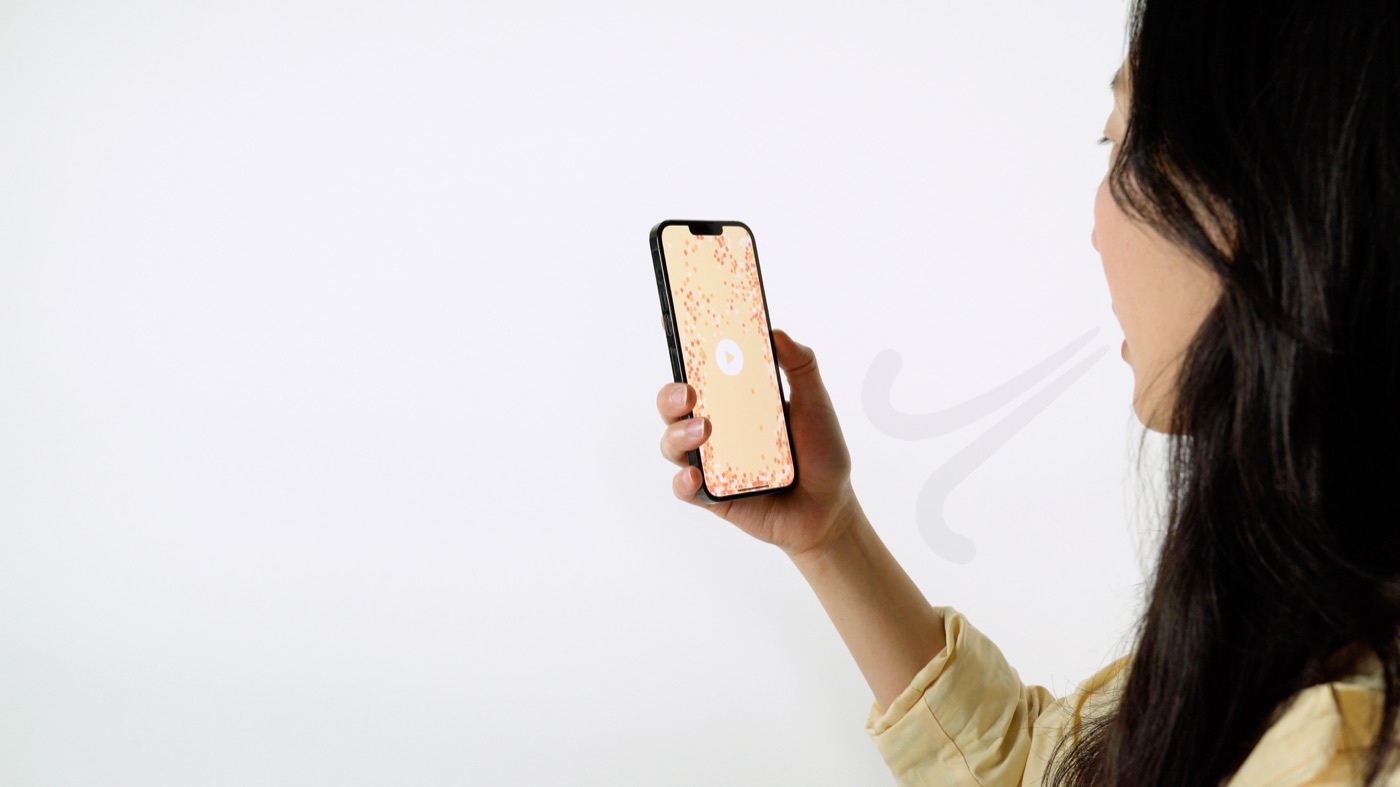
Lungy uses a different signal. It listens to your out-breath through the iPhone's microphone and moves the scene on screen as you breathe. We built it that way because practice is easier to keep up when the screen responds to you rather than counting down at you. That is our view as the people who make it. Breath-led visuals like Lungy's have not been tested against a plain timer in a trial, so we won't claim they work better.
A breathing exercise to try now
- Sit or lie comfortably and let your shoulders drop.
- Breathe in gently through your nose for a count of 4.
- Breathe out slowly through your mouth for a count of 6, as if cooling a spoonful of soup.
- Keep going for two to five minutes. If you feel light-headed, stop and breathe normally.
The NHS suggests a similar routine for stress (NHS). To follow a guide instead, try bedtime breathing, which has a longer out-breath, or coherent breathing at about five and a half breaths a minute. Both are free in your browser, with no app needed.
Curious what is happening in your body as you do it? Our free guide What happens when we breathe? explains it, and Self-care for anxiety covers what anxiety is and how breathing fits in.
How to choose a breathing app
- Pick one you will actually open. Regular practice matters more than features, so choose the one you enjoy using.
- Look for slow, exhale-focused exercises, such as coherent breathing or longer out-breaths. Fast, forceful styles are a different practice and aren't for everyone.
- Check what is free. Most charge a subscription, so try it before you pay.
- Be wary of big claims. If an app says it is proven, ask whether a trial tested that app, and what it was compared with.
- Check privacy. A breathing app shouldn't need an account or your contacts. Lungy needs neither, and your breathing data stays on your phone.
We compared eight apps, including ours, in the best breathing apps in 2026.
When an app is not enough
Breathing exercises are self-care, not treatment. See a GP if anxiety lasts for weeks, keeps coming back, or gets in the way of work, sleep or relationships (NHS). In England you can also refer yourself to NHS Talking Therapies for talking therapies such as cognitive behavioural therapy (CBT).
If you are in crisis or think you might harm yourself, call 999 or go to A&E. In the UK and Ireland you can call Samaritans free on 116 123, day or night. Elsewhere, call your local emergency number. See also our medical disclaimer.
Common questions
Do breathing apps work for anxiety?
Breathing exercises do, modestly: in trials, people reported small to medium reductions in stress and anxiety. An app is one way to do them. There is evidence that an exercise in an app can ease anxiety in the moment, but no app has been shown to work better than another.
What is the best breathing exercise for anxiety?
No single exercise has been shown to be best. Reviews pool many kinds of breathwork. In one trial, cyclic sighing (two breaths in through the nose, then a long breath out) improved mood more than mindfulness meditation. Breathing in for 4 and out for 6 is a simple, gentle place to start.
How quickly does a breathing exercise work?
It varies. In one large trial, a short breathing exercise in an app eased anxiety straight away compared with reading a text. In another, people practised for five minutes a day for a month. There is no proven minimum, so a few minutes a day is a reasonable place to start.
Can a breathing app replace therapy?
No. Breathing exercises can sit alongside treatment, but if anxiety is persistent or affecting daily life, speak to a GP. In England you can refer yourself to NHS Talking Therapies.
Is Lungy free?
Lungy gives you one exercise a day free. The rest needs Lungy Deluxe, $29.99 a year. It is iPhone only. Our guided exercises at lungy.app/breathe are free in any browser.
Sources
Checked on 24 November 2026. Spotted something wrong? Tell us and we will fix it.
- Fincham GW, Strauss C, Montero-Marin J, Cavanagh K. Effect of breathwork on stress and mental health: a meta-analysis of randomised-controlled trials. Scientific Reports 13, 432 (2023). doi.org/10.1038/s41598-022-27247-y
- Balban MY et al. Brief structured respiration practices enhance mood and reduce physiological arousal. Cell Reports Medicine 4, 100895 (2023). doi.org/10.1016/j.xcrm.2022.100895
- Sandkühler JF et al. The immediate impact of app-based psychotherapeutic exercises on anxiety: an RCT. Depression and Anxiety 2025, 5586831 (2025). doi.org/10.1155/da/5586831
- Pham Q et al. Feasibility and efficacy of an mHealth game for managing anxiety: "Flowy" randomized controlled pilot trial and design evaluation. Games for Health Journal 5(1), 50–67 (2016). doi.org/10.1089/g4h.2015.0033
- Goessl VC, Curtiss JE, Hofmann SG. The effect of heart rate variability biofeedback training on stress and anxiety: a meta-analysis. Psychological Medicine 47(15), 2578–2586 (2017). doi.org/10.1017/S0033291717001003
- NHS: Breathing exercises for stress, Generalised anxiety disorder in adults, NHS Talking Therapies

