
How long should you do breathing exercises each day?
There is no agreed amount. In one well-known trial, people practised for five minutes a day for a month, and a review of 12 trials found no clear link between how long people practised and how much their stress fell. A few minutes on most days is a sensible place to start.
The short answer
- No proven minimum or ideal. Trials have used very different amounts of practice, and a review found no clear dose effect.
- Five minutes a day was the dose in a Stanford trial, where people in the breathing groups reported a lift in positive mood over a month.
- More days may help. In that trial, for people doing cyclic sighing, the daily lift in positive mood grew the more days they had practised.
- Stop if you feel light-headed, and breathe normally.
What the research says
Five minutes a day, for a month. In a remote trial at Stanford, 108 adults, most of them students, were randomly assigned to one of three breathing exercises or to mindfulness meditation. People with moderate or severe conditions that taking part could worsen were excluded. They were asked to practise for five minutes, once a day, for 28 days. On average, the breathing groups practised on about 20 of the 28 days. The breathing groups reported a bigger rise in positive mood than the meditation group, a difference that was significant for cyclic sighing, a pattern with a long, slow breath out. There was no difference between the groups in how much anxiety or negative mood changed (Balban 2023).
More practice was not clearly better. A meta-analysis pooled 12 randomised trials with 785 adults and found breathwork was linked to modestly lower self-reported stress. The minimum practice time the trials set ranged from 80 to 5,625 minutes. The researchers found no significant link between the amount of practice, the number of sessions or how often people practised, and how much stress fell. They noted that many trials did not record how much people actually practised, so a true dose comparison was not possible (Fincham 2023).
Some trials used longer courses. In a small trial of 40 healthy adults, one group trained in slow diaphragmatic breathing for 20 sessions over 8 weeks. Afterwards that group reported less negative mood than at the start, and had lower levels of cortisol, a stress hormone measured in saliva, while the comparison group's cortisol did not change (Ma 2017).
In plain terms: short daily practice has been tested, and nobody yet knows the ideal amount. Choose an amount you can keep up.
A simple routine to start
- Attach it to something you already do, like making a morning coffee or getting into bed.
- Set a timer for five minutes, or two if five feels like a lot.
- Choose one slow exercise. Breathing in for 4 and out for 6 is a gentle start. Or follow a free guide: coherent breathing, box breathing or, at night, bedtime breathing.
- Keep going for a few weeks before you decide whether it is for you. The Stanford trial ran for a month.
- If you feel light-headed or dizzy, stop and breathe normally.
Slow breathing and fast breathing are different practices
Most of our free guides use slow breathing. The Stanford trial also tested a fast style: one of its three exercises, cyclic hyperventilation with retention, used longer breaths in and shorter breaths out. Cyclic sighing, which ends each breath with a long, slow breath out, was the only one whose lift in positive mood was significantly bigger than meditation's (Balban 2023). Fast, forceful breathing is a different practice from the slow breathing in our guides. Our free guide What happens when we breathe? explains hyperventilation.
Breathing exercises are self-care, not treatment. If stress, anxiety or trouble sleeping is persistent, speak to a doctor. See our medical disclaimer.
Where Lungy fits
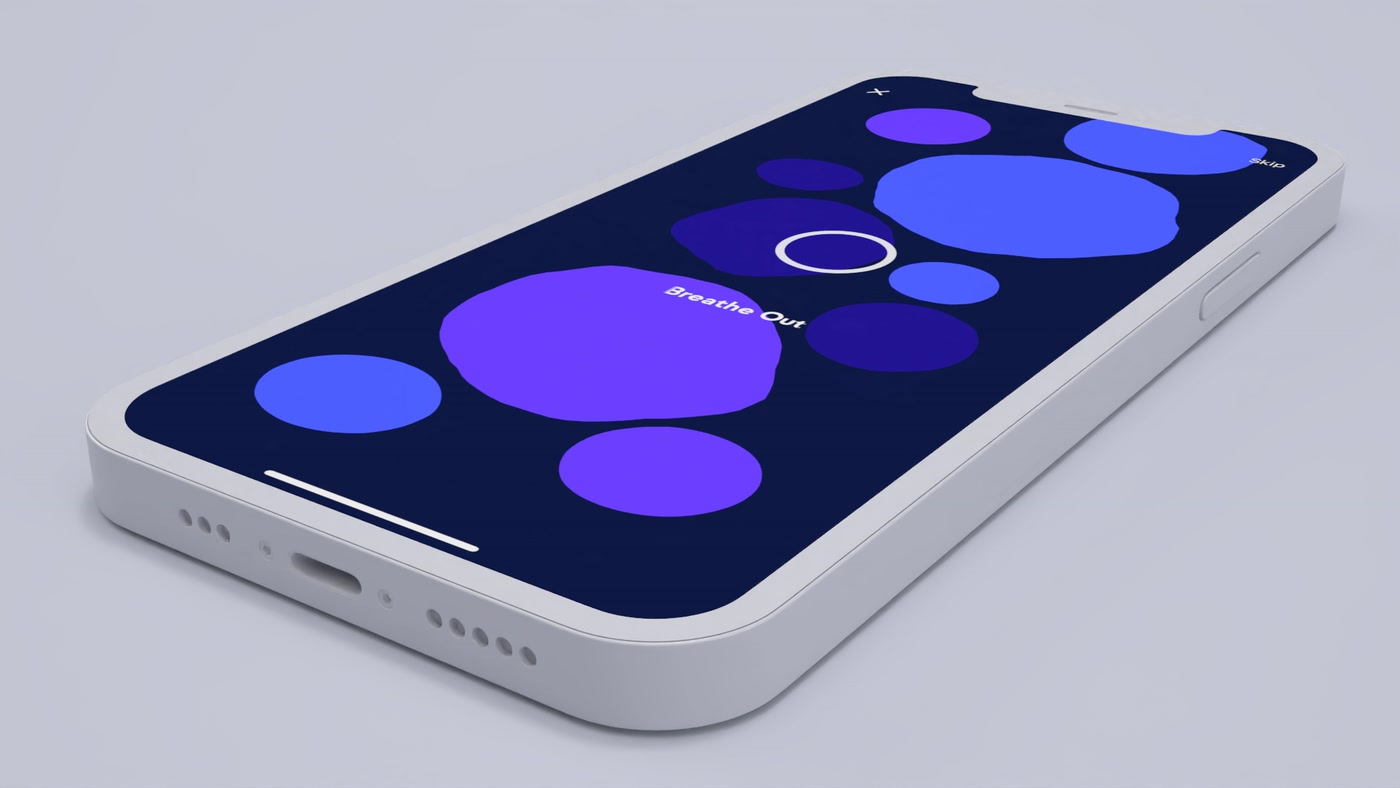
Lungy is designed for short, regular sessions. You get a new exercise each day, and the scene on screen moves as you breathe out, using the iPhone's microphone and camera together. After a session, it shows how many breaths you completed and your approximate breath volume, shown as a piece of fruit.

Where it falls short: Lungy is iPhone only, it has no voice-led classes, and it works best somewhere quiet. One exercise a day is free; the rest needs Lungy Deluxe, $29.99 a year. If you would rather not install anything, our guided exercises are free in the browser. For different ways to pace yourself, see breathing visuals.
Common questions
How many minutes a day should I do breathing exercises?
There is no proven number. A Stanford trial used five minutes a day for a month, and a review of 12 trials found no clear link between the amount of practice and the drop in stress. Five minutes on most days is a reasonable start.
Is it better to do breathing exercises in the morning or at night?
We know of no trial that compared times of day. Pick the time you are most likely to stick to. If you practise at night, keep it slow and gentle, like our bedtime breathing guide.
How long before breathing exercises make a difference?
Nobody knows for sure. In the Stanford trial, mood was measured before and after each daily session, and for cyclic sighing the lift grew the more days people had practised.
Is Lungy free?
Lungy gives you one exercise a day free. The rest needs Lungy Deluxe, $29.99 a year. It is iPhone only. Our guided exercises at lungy.app/breathe are free in any browser.
Sources
Checked on 24 November 2026. Spotted something wrong? Tell us and we will fix it.
- Balban MY et al. Brief structured respiration practices enhance mood and reduce physiological arousal. Cell Reports Medicine 4, 100895 (2023). doi.org/10.1016/j.xcrm.2022.100895
- Fincham GW, Strauss C, Montero-Marin J, Cavanagh K. Effect of breathwork on stress and mental health: a meta-analysis of randomised-controlled trials. Scientific Reports 13, 432 (2023). doi.org/10.1038/s41598-022-27247-y
- Ma X et al. The effect of diaphragmatic breathing on attention, negative affect and stress in healthy adults. Frontiers in Psychology 8, 874 (2017). doi.org/10.3389/fpsyg.2017.00874
- Lungy: App Store listing, TechRadar review (July 2025)
